
2026 Archer fellows head to the Hill
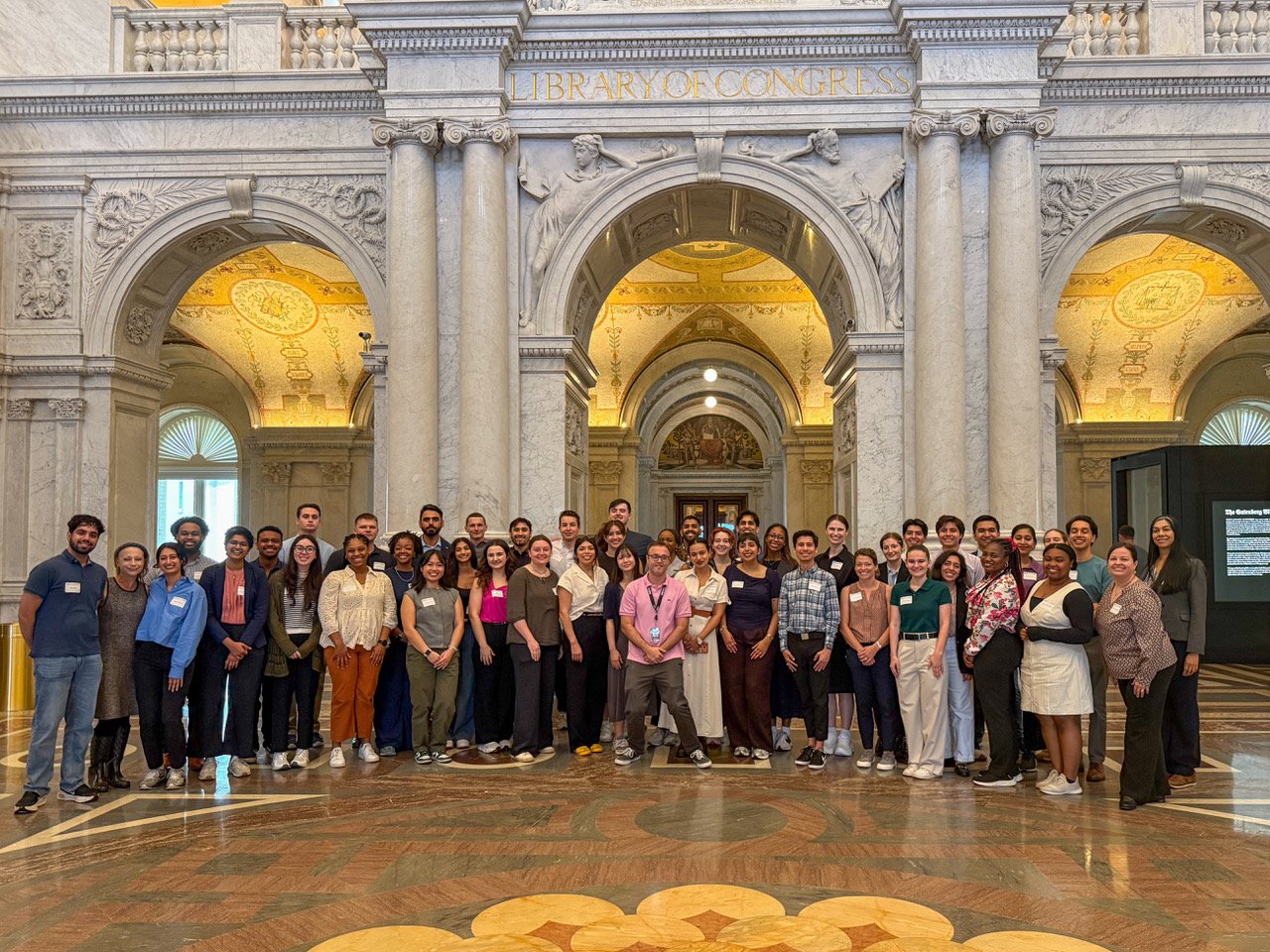
UTHealth Houston School of Public Health students head to the heart of public health policy each summer under the Graduate Archer Fellowship Program. Students from across The University of Texas System spend their summer semester in Washington, DC, learning about policymaking from national experts and to experience firsthand the federal policymaking environment through internships.
Fellows participate in immersive internships across congressional offices, federal departments, nonprofit organizations, advocacy organizations, and policy think tanks, contributing to real-time public policy efforts while deepening their understanding of complex national and global issues. The experience pairs health policy academic coursework with hands-on professional engagement, preparing students with the skills and perspective needed to lead and drive change in their respective fields.
Congratulations to the 2026 Graduate Archer Fellows:
- Shayanne Martin
- Leslie Omeire
- Jordan Sanchez
- Hugo Sanchez Blas
- Wallis Turley
Shayanne Martin
For PhD student Shayanne Martin, MPH, the path to health policy has been shaped by both professional experience and personal purpose.
After earning her MPH from the Johns Hopkins Bloomberg School of Public Health, Martin built a career in global health, working across sub-Saharan Africa to strengthen health workforce development and optimize HIV care delivery. Her focus shifted after her daughter was diagnosed with a rare genetic disease at just six weeks old, inspiring her to pursue research training and dedicate her work to improving patient-centered research infrastructure for families facing similar challenges.
"After my daughter was diagnosed with a rare genetic disease, I pivoted from global health to community health to work closer to home," Martin said. Her family moved to Texas, where they could find support. After settling in San Antonio, Martin started her doctoral degree in the Behavioral Sciences and Health Promotion program at the School of Public Health.
While her work now centers on rare disease advocacy, Martin said the principles of public health continue to guide her approach.
"I've always loved that global public health aims to create the greatest benefit for the greatest number of people at the lowest cost," Martin said. "Advocating for individuals with rare diseases may seem different, but 1 in 10 Americans suffer from a rare disease. Both fields are ultimately focused on improving lives, reducing barriers to care, and creating systems that better serve vulnerable communities."
This summer, Martin is interning with the EveryLife Foundation for Rare Diseases, where she is exploring patient-focused drug development and regulatory flexibility to support families who have faced situations similar to hers—a child diagnosed with a disease that has no treatment. She hopes to examine solutions that can drive treatment innovation for individuals living with rare diseases. Her work will focus on creating evidence-based policy recommendations to accelerate drug development for rare diseases.
The fellowship aligns closely with Martin's personal mission. Following her daughter's diagnosis, she founded a nonprofit organization, the Channeling Hope Foundation, dedicated to finding treatments for patients affected by ultra-rare NALCN diseases.
"I'm looking forward to having conversations with experts in the rare disease regulatory space," Martin said. "Being in this space and bringing this knowledge back to Texas will help support my nonprofit and others advance rare disease policy and advocacy. As a patient advocacy organization, we’re not just supporters of the drug development pipeline; we are a part of it. We're helping build the evidence base for the FDA to approve life-changing treatments."
For Martin, the work is rooted in patients being at the table with FDA, pharma, and academia to create meaningful change.
Leslie Omeire
For Leslie Omeire, a dual-degree MD/MPH student with UT Health San Antonio and UTHealth Houston, public health policy offers an opportunity to bridge medicine, advocacy, and action.
Public health provided a foundation for Omeire to begin to question systemic issues and community health across the population. She not only wanted to focus on medicine but also to go beyond the clinic and lead change at the individual and community health levels.
"As I approached my latter years of undergrad, I found myself in deep tension with my interest in medicine," shared Omeire. "After much reflection, I realized that what I perceived as a shortcoming in medicine was truly a call to action."
That realization led her to pursue a dual degree to combine these interests, which would provide her with expertise in and outside hospital settings, such as a state representative's office, a juvenile detention center, and the Texas Capitol. It was these experiences that led her to the Graduate Archer Fellowship, which would allow her to spend her summer with the Association of Maternal and Child Health Programs (AMCHP) as a Policy and Government Affairs Intern with the Health Policy Working Group.
"This program represents an opportunity to grow as a leader committed to my civic responsibility and to share my voice with humility and purpose. I am eager to bring my lived experiences, medical training, and passion for both justice and compassion to this transformative program while learning from the incredible lives of my Graduate Archer Fellow cohort, a community of brilliant and passionate individuals."
Omeire's policy interests center on maternal and child health with a personal experience that has shaped her commitment to advancing women's and family health as an aspiring obstetrician-gynecologist applying to OB-GYN residency this year.
"As the daughter of Nigerian immigrants and the younger sibling to a beloved sister with special health care needs, these deeply intimate experiences have shaped my perspective, grounding my work in empathy, cultural humility, and profound respect for the lived experiences of the communities I serve."
Jordan Sanchez
Dual-degree MD/MPH student Jordan Sanchez plans to spend her summer advancing maternal and child health in the capital.
Originally from rural New Mexico, Sanchez said witnessing health disparities firsthand in her hometown inspired her to pursue public health alongside medicine, where she's completing her studies at McGovern Medical School.
Alongside direct patient care, she also wants to understand the inequities that can contribute to negative health outcomes and the struggles impacting patients outside the clinic or hospital. Through this, Sanchez sought to broaden her horizons at the US House of Representatives before starting her graduate education. "I gained valuable insight into the policymaking process, particularly in health and education policy, which affirmed my desire to pursue a career at the intersection of medicine and public policy," she shared.
This summer, she'll head back to Washington, DC, where she's eager to build connections within the program and throughout the city.
"I absolutely loved my time living and working in DC and knew I would go back eventually, but I didn't realize I would have the opportunity so soon. The Graduate Archer Fellowship is an unmatched opportunity to expand my policy knowledge, collaborate with public health leaders, and translate research into tangible solutions."
Sanchez will work with the Health Policy Independent Study and Research Group, interning with the National Partnership for Women and Families on its Congressional Relations and Social Impact team. For her, this is the perfect public health policy and medical fit as she hopes to pursue a career in obstetrics and gynecology. "
Rural communities across the U.S. face a disproportionate crisis in access to obstetric care. Many rural hospitals have been forced to close their labor and delivery units due to financial strain, staff shortages, and low reimbursement rates," said Sanchez. "I have seen this in my own community, so working at the intersection of improving women's healthcare and expanding access to care in rural areas deeply resonates with me."
Hugo Sanchez Blas
For Hugo Sanchez Blas, a first-year doctoral student in Behavioral Sciences and Health Promotion, the Archer Fellowship provides an opportunity to explore how evidence-based public health interventions are translated into policy.
“By studying policymaking and advocacy in Washington, D.C., I hope to better understand how policy can be leveraged to support the implementation of evidence-based practices and improve their accessibility,” Sanchez Blas said.
Before beginning his doctoral studies, Sanchez Blas earned his medical degree from the National Autonomous University of Mexico. While his clinical training focused on treating disease at the individual level, he became increasingly interested in the broader social and behavioral factors that shape health outcomes.
“Given the complexity of health in all its dimensions, I wanted to expand my understanding of disease to a broader systems perspective,” he said.
That interest led him to public health, where he found an opportunity to address the root causes of disease and improve health on a larger scale.
“Public health represents a means to address root causes and design interventions that can improve health at scale,” Sanchez Blas said.
While completing his MPH at UTHealth Houston School of Public Health this past spring, Sanchez Blas developed a growing interest in policymaking and advocacy. The Archer Fellowship offered a unique opportunity to use policy to support the development of healthier environments.
His policy interests include strengthening cancer prevention and control efforts and identifying policy solutions that improve access to health care.
“As I have become more immersed in policy, I have grown increasingly interested in identifying the root causes of challenges within the health care system,” Sanchez Blas said. “Through the Archer Fellowship, I look forward to working alongside policy experts and practitioners to develop policy solutions that improve cancer control and expand health care access.”
Wallis Turley
Wallis Turley, a second-year MPH student in health services organizations, views public policy as a powerful tool for improving population health long before individuals enter a clinical setting.
Her passion for public service began during her undergraduate years in Washington, DC, where she earned a bachelor’s degree in international studies with a concentration in global health at American University. While interning for a member of Congress, she saw firsthand how policy decisions shape people’s lives. The experience affirmed her desire to build a career in public health that is grounded in the principles of public service.
“For me, public service and public health are inseparable. Public service fuels my commitment to improving systems and strengthening communities, while public health provides the framework and tools to make that impact effective and lasting,” Turley said.
That motivation led her to the Archer Fellowship, where she sought to understand how ideas move from research to legislation and how those choices affect communities. “The fellowship allowed me to take what I’ve learned in my health economics classes and apply it directly to current policy challenges,” she said.
This summer, Turley is interning at the O’Neill Institute for National and Global Health Law. She works on translating research into policy guidance that supports addiction prevention, treatment access, and long-term recovery.
Her service driven approach also extends into higher education. Through the Education Policy Working Group she is studying how addiction affects college students and how campus policies can support their health and recovery.
“Education policy plays a major role in public health because the overall learning environment shapes whether students have what they need to stay healthy and succeed. For college students, that includes how campuses recognize and respond to addiction and whether students can access the support they need,” Turley said.